How much memory do you need to run a local LLM on a Mac?
Not "how fast is your Mac" — how much memory it has. That single number decides which local models you can run, and the answer is more generous than most people expect right up until it isn't.
Every "can my Mac run this model?" thread ends up at the same place: it depends on RAM. Not the chip, not the core count — the unified memory, because the weights have to sit in it.
So we measured it. Every model rapid-mlx serves, at its smallest usable quantization, sized from the actual checkpoints. Then, where Artificial Analysis has scored the model, we plotted that against it.
The short version: 64 of the 82 models fit in 24 GB. A base MacBook Air runs 38 of them. What you cannot buy at any price is the top-right of that chart.
The map
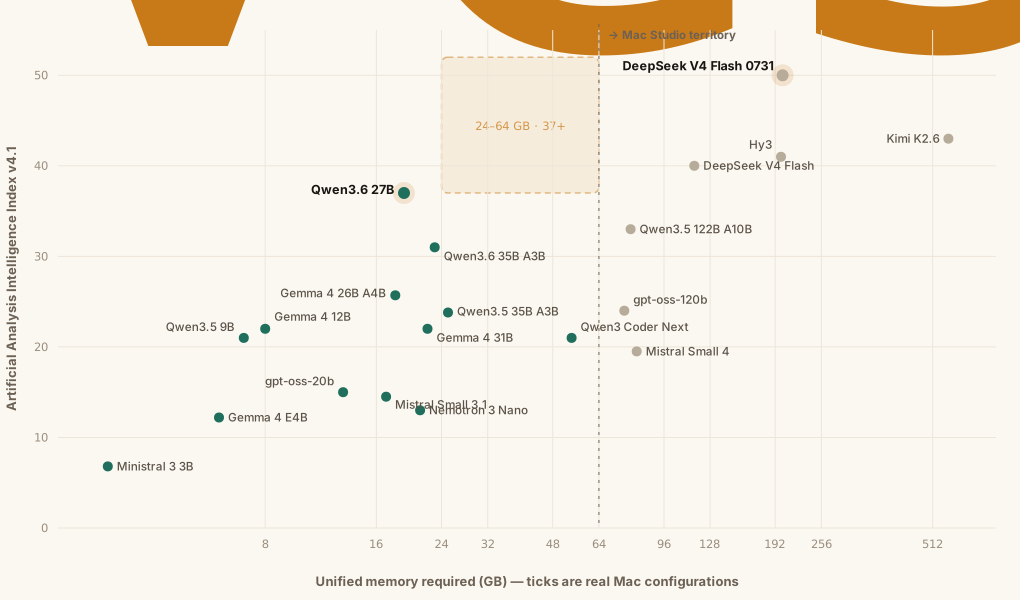
The horizontal axis is the thing that actually constrains you. The vertical axis is the Artificial Analysis Intelligence Index v4.1 — a composite of reasoning, coding and agentic benchmarks.
Three things fall out of it.
A 24 GB Mac gets you to 37. That is Qwen3.6 27B, and it is the ceiling for the machine most people own. It is also a genuinely useful model — tool calling, long context, agentic workloads.
The 50-point model needs a $10,000 machine. DeepSeek V4 Flash 0731 is the most capable open-weights model we serve. Its smallest quantization is 167 GB of weights, so it wants a 256 GB Mac Studio. Kimi K2.6 asks for 471 GB — more than any Mac ships with.
Between them is a hole. Nothing sits in the 24–64 GB band above 37 points. Not because we skipped it: no released open-weights model belongs there. Everything scoring above 37 on that index has 300 B+ parameters, and 300 B parameters do not fit in 64 GB at any quantization anyone ships today.
That gap is the whole game for local inference. A 40-point model that fits in 48 GB would be worth more to Mac users than another 500 B model that only a maxed Studio can load. It is a compression problem, not a catalog problem — which is why deepseek-v4-flash-2bit (2-bit, 96 GB, down from 151 GB at 4-bit) and bonsai-27b-2bit (a 27 B model in 8.5 GB) matter more than they look.
The one number to memorise
If you do not want to look anything up, this gets you close for a 4-bit model:
weights (GB)  ≈  parameters (B) × 0.6
usable RAM    ≈  total RAM − 3 GB for macOS − your KV cache
That 0.6 is not a guess — it is the median across the 58 four-bit checkpoints in our registry that name their parameter count. Half land between 0.57 and 0.70.
Two places it breaks. Big MoE models come in leaner — gpt-oss-120b and Qwen3.5 122B both sit near 0.52, because much of the parameter count is in experts that quantize well. Small models come in fatter — Gemma 3n E2B is 2.25 GB per billion, since embeddings and the vocabulary do not shrink with the transformer body and they dominate a 2 B model. Below about 4 B, ignore the formula and read the number.
Leave room for the context
The formula above sizes the weights. The KV cache is on top, it grows with context length, and it is the thing that turns "it loaded fine" into a swap death spiral three turns into a long conversation.
Rapid-MLX quantizes the live KV cache to int4 by default, which is most of why these numbers work at all — but a 128k-token context still costs real memory. If a model only just fits, it does not fit.
Why the cost axis lies to you
Artificial Analysis plots intelligence against cost per task, which is the right axis for an API buyer and the wrong one for you. Two reasons.
Run the model locally and the marginal cost is electricity. The x-axis collapses.
Worse, it inverts. Mixture-of-experts models look cheap per task because each token only activates a slice of the network — but you still have to hold every parameter in memory. MiMo-V2.5 is the cheapest 37-point model on the AA chart at $0.011 per task. It is also 311 B parameters. On a Mac it is one of the least runnable models on the entire chart.
So a model being cheap in the cloud tells you nothing about whether your laptop can load it, and sometimes tells you the opposite.
What fits, by machine
Sizes are the download for the smallest usable quantization. Budget roughly 20% on top for the KV cache and activations — more if you run long contexts.
8 GB — the base MacBook Air
Every one of these fits on the cheapest Apple Silicon Mac sold today.
38 models fit.
| alias | download | model |
|---|---|---|
qwen3.5-9b-4bit |
6.0 GB | mlx-community/Qwen3.5-9B-4bit |
gemma-3n-e4b-4bit |
5.9 GB | lmstudio-community/gemma-3n-E4B-it-MLX-4bit |
ui-tars-7b-dpo-4bit |
5.7 GB | mlx-community/UI-TARS-7B-DPO-4bit |
ui-tars-7b-sft-4bit |
5.7 GB | mlx-community/UI-TARS-7B-SFT-4bit |
gemma-4-e4b-4bit |
5.2 GB | mlx-community/gemma-4-e4b-it-4bit |
tmax-9b |
5.1 GB | mlx-community/Tmax-9B-MLX-4bit |
qwopus-9b-4bit |
5.1 GB | Jackrong/MLX-Qwopus3.5-9B-v3-4bit |
ui-tars-1.5-7b-4bit |
4.9 GB | mlx-community/UI-TARS-1.5-7B-4bit |
lfm2.5-8b-a1b-4bit |
4.8 GB | mlx-community/LFM2.5-8B-A1B-MLX-4bit |
qwen3-8b-4bit |
4.6 GB | mlx-community/Qwen3-8B-4bit |
deepseek-r1-8b-4bit |
4.6 GB | mlx-community/DeepSeek-R1-0528-Qwen3-8B-4bit |
llama-3.1-8b-4bit |
4.5 GB | mlx-community/Meta-Llama-3.1-8B-Instruct-4bit |
hermes3-8b-4bit |
4.5 GB | mlx-community/Hermes-3-Llama-3.1-8B-4bit |
gemma-3n-e2b-4bit |
4.5 GB | mlx-community/gemma-3n-E2B-it-4bit |
qwen3-4b-8bit |
4.3 GB | mlx-community/Qwen3-4B-8bit |
granite4-tiny-4bit |
3.9 GB | mlx-community/granite-4.0-h-tiny-4bit |
gemma-4-e2b-4bit |
3.6 GB | mlx-community/gemma-4-e2b-it-4bit |
vibethinker-3b-8bit |
3.3 GB | mlx-community/VibeThinker-3B-8bit |
qwen3.5-4b-4bit |
3.1 GB | mlx-community/Qwen3.5-4B-MLX-4bit |
gemma3-4b-qat-4bit |
3.0 GB | mlx-community/gemma-3-4b-it-qat-4bit |
ministral-3b-4bit |
2.8 GB | mlx-community/Ministral-3-3B-Instruct-2512-4bit |
qwen3-4b-thinking-2507-4bit |
2.3 GB | mlx-community/Qwen3-4B-Thinking-2507-4bit |
qwen3-4b-instruct-2507-4bit |
2.3 GB | mlx-community/Qwen3-4B-Instruct-2507-4bit |
phi-4-mini-4bit |
2.2 GB | mlx-community/phi-4-mini-instruct-4bit |
nanbeige4.1-3b-4bit |
2.2 GB | mlx-community/Nanbeige4.1-3B-4bit |
phi-4-mini-reasoning-4bit |
2.2 GB | lmstudio-community/Phi-4-mini-reasoning-MLX-4bit |
phi-3.5-mini-4bit |
2.2 GB | mlx-community/Phi-3.5-mini-instruct-4bit |
llama3-3b-4bit |
1.8 GB | mlx-community/Llama-3.2-3B-Instruct-4bit |
granite4-h-micro-4bit |
1.8 GB | mlx-community/granite-4.0-h-micro-4bit |
smollm3-3b-4bit |
1.7 GB | mlx-community/SmolLM3-3B-4bit |
qwen3-1.7b-4bit |
1.0 GB | mlx-community/Qwen3-1.7B-4bit |
vibethinker-1.5b-4bit |
0.9 GB | mlx-community/VibeThinker-1.5B-mlx-4bit |
gemma3-1b-qat-4bit |
0.8 GB | mlx-community/gemma-3-1b-it-qat-4bit |
llama3-1b-4bit |
0.7 GB | mlx-community/Llama-3.2-1B-Instruct-4bit |
lfm2.5-1b-4bit |
0.7 GB | mlx-community/LFM2.5-1.2B-Instruct-4bit |
minicpm5-1b-4bit |
0.6 GB | openbmb/MiniCPM5-1B-MLX |
bonsai-1.7b-2bit |
0.5 GB | prism-ml/Ternary-Bonsai-1.7B-mlx-2bit |
qwen3-0.6b |
0.4 GB | mlx-community/Qwen3-0.6B-4bit |
16 GB
9 models fit.
| alias | download | model |
|---|---|---|
devstral-24b-4bit |
13.3 GB | mlx-community/Devstral-Small-2507-4bit |
gpt-oss-20b-mxfp4-q4 |
11.2 GB | mlx-community/gpt-oss-20b-MXFP4-Q4 |
gpt-oss-safeguard-20b |
11.2 GB | lmstudio-community/gpt-oss-safeguard-20b-MLX-MXFP4 |
deepseek-coder-v2-lite-16b-4bit |
8.8 GB | mlx-community/DeepSeek-Coder-V2-Lite-Instruct-4bit-mlx |
bonsai-27b-2bit |
8.5 GB | prism-ml/Ternary-Bonsai-27B-mlx-2bit |
qwen2.5-14b-4bit |
8.3 GB | mlx-community/Qwen2.5-14B-Instruct-4bit |
phi-4-14b-4bit |
8.3 GB | mlx-community/phi-4-4bit |
gemma3-12b-4bit |
8.1 GB | mlx-community/gemma-3-12b-it-qat-4bit |
gemma-4-12b-4bit |
6.8 GB | mlx-community/gemma-4-12B-it-4bit |
24 GB
The sweet spot: this is where the strongest small-machine models live.
17 models fit.
| alias | download | model |
|---|---|---|
qwen3.6-35b-mxfp4 |
19.3 GB | mlx-community/Qwen3.6-35B-A3B-mxfp4 |
gemma-4-31b-4bit |
18.4 GB | mlx-community/gemma-4-31b-it-4bit |
deepseek-r1-32b-4bit |
18.4 GB | mlx-community/DeepSeek-R1-Distill-Qwen-32B-4bit |
nemotron-30b-4bit |
17.8 GB | lmstudio-community/NVIDIA-Nemotron-3-Nano-30B-A3B-MLX-4bit |
qwen3-coder-30b-4bit |
17.2 GB | mlx-community/Qwen3-Coder-30B-A3B-Instruct-4bit |
glm4.7-9b-4bit |
16.9 GB | mlx-community/GLM-4.7-Flash-4bit |
gemma3-27b-qat-4bit |
16.9 GB | mlx-community/gemma-3-27b-it-qat-4bit |
diffusion-gemma-26b-4bit |
16.6 GB | mlx-community/diffusiongemma-26B-A4B-it-4bit |
qwen3.5-27b-4bit |
16.1 GB | mlx-community/Qwen3.5-27B-4bit |
qwen3.6-27b |
16.1 GB | mlx-community/Qwen3.6-27B-4bit |
gemma-4-26b-qat-4bit |
15.6 GB | mlx-community/gemma-4-26B-A4B-it-qat-4bit |
gemma-4-26b-4bit |
15.4 GB | mlx-community/gemma-4-26b-a4b-it-4bit |
tmax-27b |
15.2 GB | mlx-community/Tmax-27B-MLX-4bit |
qwopus-27b-4bit |
15.2 GB | Jackrong/MLX-Qwopus3.5-27B-v3-4bit |
devstral-v2-24b-4bit |
15.1 GB | mlx-community/Devstral-Small-2-24B-Instruct-2512-4bit |
mistral-24b-4bit |
14.1 GB | mlx-community/Mistral-Small-3.1-24B-Instruct-2503-4bit |
lfm2-24b-a2b-4bit |
13.4 GB | lmstudio-community/LFM2-24B-A2B-MLX-4bit |
32 GB
2 models fit.
| alias | download | model |
|---|---|---|
holo3.1-35b-a3b |
23.5 GB | pipenetwork/Holo-3.1-35B-A3B-MLX-4bit |
qwen3.5-35b-4bit |
20.4 GB | mlx-community/Qwen3.5-35B-A3B-4bit |
48 GB
2 models fit.
| alias | download | model |
|---|---|---|
hermes4-70b-4bit |
39.7 GB | lmstudio-community/Hermes-4-70B-MLX-4bit |
gemma-4-31b-qat-4bit |
28.8 GB | mlx-community/gemma-4-31B-it-qat-4bit |
64 GB
Past here you are buying a Mac Studio, not a laptop.
2 models fit.
| alias | download | model |
|---|---|---|
qwen3-coder-next-80b-4bit |
44.9 GB | mlx-community/Qwen3-Coder-Next-4bit |
ui-tars-72b-dpo-4bit |
42.3 GB | mlx-community/UI-TARS-72B-DPO-4bit |
96 GB
4 models fit.
| alias | download | model |
|---|---|---|
mistral-small-4-119b-4bit |
67.8 GB | mlx-community/Mistral-Small-4-119B-2603-4bit |
qwen3.5-122b-mxfp4 |
64.9 GB | nightmedia/Qwen3.5-122B-A10B-Text-mxfp4-mlx |
gpt-oss-120b-mxfp4-q4 |
62.4 GB | mlx-community/gpt-oss-120b-MXFP4-Q4 |
glm4.5-air-4bit |
60.2 GB | mlx-community/GLM-4.5-Air-4bit |
128 GB
2 models fit.
| alias | download | model |
|---|---|---|
qwen3.5-122b-6bit |
100.1 GB | mlx-community/Qwen3.5-122B-A10B-6bit |
deepseek-v4-flash-2bit |
96.5 GB | mlx-community/DeepSeek-V4-Flash-2bit-DQ |
192 GB
2 models fit.
| alias | download | model |
|---|---|---|
minimax-m2.5-4bit |
128.7 GB | lmstudio-community/MiniMax-M2.5-MLX-4bit |
minimax-m2.7-mxfp4 |
121.5 GB | mlx-community/MiniMax-M2.7-4bit-mxfp4 |
256 GB
2 models fit.
| alias | download | model |
|---|---|---|
deepseek-v4-flash-0731-mxfp4 |
167.1 GB | Vontra/DeepSeek-V4-Flash-0731-MXFP4-MLX |
hy3-preview-4bit |
166.0 GB | mlx-community/Hy3-preview-4bit |
512 GB — maxed M3 Ultra
Kimi K2.6 asks for more than any Mac ships with — listed for completeness.
2 models fit.
| alias | download | model |
|---|---|---|
kimi-k2.6 |
470.6 GB | mlx-community/Kimi-K2.6-mlx-DQ3_K_M-q8 |
glm-5.2-reap50 |
214.4 GB | pipenetwork/GLM-5.2-REAP50-MLX-4bit |
Picking one
Rules of thumb that survive contact with real machines:
- 8–16 GB — Qwen3.5 9B or Gemma 4 12B for general work;
qwen3-4b-instruct-2507-4bitif you want headroom for a big context. Phi, Granite and SmolLM are here too if you want something smaller still. - 24 GB —
qwen3.6-27bis the pick. This is the best intelligence-per-gigabyte point on the whole chart. - 32–64 GB —
hermes4-70b-4bitorqwen3-coder-next-80b-4bitfor coding. You gain breadth, not much peak reasoning. - 96 GB+ — now the frontier opens:
qwen3.5-122b-mxfp4, thendeepseek-v4-flash-2bitat 128 GB. - 256 GB —
deepseek-v4-flash-0731-mxfp4, the 50-point model.
To see what your own machine can hold, without reading a table:
pip install rapid-mlx
rapid-mlx models          # every alias, with download size
rapid-mlx doctor          # what this Mac can actually run
Or use the live picker — choose your Mac, see what fits.
What these numbers are, and are not
We would rather over-explain this than have someone quote it wrongly.
The intelligence scores are borrowed, and they are not measured on what you will run. Artificial Analysis evaluates full-precision models served over an API. rapid-mlx runs 2/4/6/8-bit MLX quantizations. Quantization costs accuracy. We have not run the AA task set against our own quantized builds, so read every vertical position as "this model family's tier" — not "this alias scores that." Closing that gap is on our list, and it matters: if 2-bit quantization drops a 40-point model to 30, the whole "compress it into 64 GB" strategy needs rethinking.
The memory figures are ours and they are real, but they are still estimates. Weight sizes come from the actual checkpoints. The 20% headroom and the rounding up to Mac configurations are engineering judgement, not measurement. A long context, a second loaded model, or anything else on the machine will push you into the next tier.
Only 20 of the 82 models have an AA score at all. The rest — UI-TARS, Tmax, VibeThinker, Holo3, Devstral, LFM2, the Bonsai ternary builds — have never been benchmarked by Artificial Analysis, so they appear in the tables and not the chart. Absence from the plot says nothing about them.
Scores are AA Intelligence Index v4.1, read on 2026-07-31. Both the index and the model set move. rapid-mlx serves 166 text aliases; this page covers the 82 distinct models behind them.
Frequently asked questions
How much RAM do I need to run a local LLM on a Mac?
8 GB is enough to run real models — 38 of the 82 here fit, including Qwen3.5 9B and Gemma 4 12B. 16 GB is comfortable. 24 GB is the sweet spot, because that is where Qwen3.6 27B fits, the strongest model that runs on a machine most people own. Above 64 GB you are buying a Mac Studio.
Can a 16 GB MacBook Air run a local LLM?
Yes. At 4-bit quantization a 16 GB Air runs anything up to roughly 9 GB of weights — Qwen3.5 9B, Gemma 4 12B, gpt-oss-20b, Phi-4 and the whole small-model tier. Leave room for macOS and the KV cache; if a model only just fits, it does not fit.
Does a Mixture-of-Experts model use less memory?
No — only less compute. MoE activates a slice of the network per token, which makes it fast and cheap to serve, but every parameter still has to be resident. This is why MiMo-V2.5 looks like the cheapest capable model on cost-per-task charts and is simultaneously one of the least runnable on a Mac: 311 B parameters have to fit somewhere.
How do I estimate the memory a model needs?
Multiply parameters in billions by 0.6 for a 4-bit build, then subtract about 3 GB from your total RAM for macOS and leave headroom for the KV cache. The 0.6 is the median across 58 four-bit checkpoints in our registry. It breaks below ~4 B, where embeddings dominate and models come in fatter.
What is the most capable model that runs locally on a Mac?
DeepSeek V4 Flash 0731, at 50 on the Artificial Analysis Intelligence Index — but its smallest quantization is 167 GB of weights, so it needs a 256 GB Mac Studio. For a laptop, Qwen3.6 27B at 24 GB is the practical ceiling.
Related
- Every alias, quant and family — the full reference
- RAM tier map + serve flags per tier
- Rapid-MLX vs Ollama vs LM Studio — an honest comparison with a reproducible benchmark
rapid-mlx serve <alias> serves any model on
localhost:8000/v1.
curl -fsSL https://rapidmlx.com/install.sh | bash
New models and speedups, in your inbox
A short note whenever rapid-mlx gets faster or adds models worth running on your Mac. No spam — unsubscribe anytime.